
You’re ready to apply for a marriage-based green card. You’ve researched the process, maybe even looked at the forms. But now comes the question that overwhelms most couples: what documents do you actually need to prove your case?
The exact documents depend on your situation. But here’s the good news: while the list looks long, many of these documents you already have or can get quickly.
This guide covers the common documents needed to apply for a green card through marriage, whether you’re filing through adjustment of status (AOS) or consular processing. We’ll break down what’s usually required for each pathway, explain what USCIS and the State Department look for when reviewing evidence of a bona fide marriage, and share common mistakes.
Incomplete document packages are one of the top reasons for Requests for Evidence (RFEs), which can add 3-6 months to your timeline. Getting your documents right the first time keeps your case moving forward.
Want a printable version? Download our free Marriage Green Card Document Checklist to track everything you need.
Table of Contents
Two Pathways: Adjustment of Status vs. Consular Processing
Before diving into the document checklist, you need to know which pathway applies to you.
Adjustment of Status (AOS) is for couples where the foreign spouse is already in the United States with valid immigration status. You file everything with USCIS, attend an interview at a local USCIS field office, and stay in the U.S. while your case is processed.
Consular Processing is for couples where the foreign spouse is outside the United States. The U.S. spouse files Form I-130 with USCIS, then the case transfers to the National Visa Center (NVC) and finally to a U.S. embassy or consulate abroad for the interview.
Here’s a quick table comparing Adjustment of Status and Consular Processing pathways:
| Factor | Adjustment of Status | Consular Processing |
|---|---|---|
| Where is foreign spouse? | In the U.S. | Outside the U.S. |
| Where do you file? | USCIS | USCIS → NVC → Embassy |
| Key forms | I-130, I-485, I-864 | I-130, DS-260, I-864 |
| Interview location | Local USCIS field office | U.S. Embassy abroad |
Documents Needed to Apply for a Green Card Through Marriage: Complete Checklist
This master checklist covers the documents couples usually need for their marriage-based green card applications. Use this as your adjustment of status checklist, or consular processing checklist depending on your pathway – the columns show which documents apply to each.
| Document Category | Document Examples | Related Form(s) | AOS | Consular |
|---|---|---|---|---|
| PETITIONER (U.S. SPONSOR) | ||||
| Identity & U.S. Status | Passport, birth certificate or naturalization certificate (if U.S. Citizen), OR green card (if LPR) | I-130 | ✓ | ✓ |
| Passport Photos | 2 passport-style photos (2″x2″) | I-130 | ✓ | ✓ |
| Prior Marriage Termination | Divorce decrees, death certificates OR annulment papers (if applicable) | I-130 | ✓ | ✓ |
| Name Change Proof | Court order OR marriage certificate showing name change (if applicable) | I-130 | ✓ | ✓ |
| FINANCIAL DOCUMENTS (I-864) | ||||
| Tax Records | IRS tax transcripts (most recent year; 3 years preferred) | I-864 | ✓ | ✓ |
| Employment Income | 6 months of pay stubs, letter from employer (if employed) | I-864 | ✓ | ✓ |
| Self-Employment Income | Form 1040 schedules (if self-employed) | I-864 | ✓ | ✓ |
| Joint Sponsor Documents | Same financial docs as above (if income insufficient) | I-864 | ✓ | ✓ |
| BENEFICIARY (FOREIGN SPOUSE) | ||||
| Identity | Valid passport (biographic page) AND long-form birth certificate with parents’ names | I-485 / DS-260 | ✓ | ✓ |
| Passport Photos | 2-4 passport-style photos (2″x2″) | I-130, I-485 / DS-260 | ✓ | ✓ |
| Proof of Lawful U.S. Entry | I-94 arrival record, passport entry stamp AND U.S. visa page (if applicable) | I-485 | ✓ | |
| Prior Marriage Certificate(s) | Certified copy of marriage certificate for every prior marriage (if applicable) | DS-260 | ||
| Prior Marriage Termination | Divorce decrees, death certificates, annulment papers (if applicable) | I-485 / DS-260 | ✓ | ✓ |
| Police Certificates | From EVERY country lived 12+ months after age 16 | DS-260 | ✓ | |
| Criminal/Court Records | Certified court and prison records (if any arrests/convictions) | I-485 / DS-260 | ✓ | ✓ |
| Waivers of inadmissibility | Any waivers of inadmissibility (if applicable) | I-485 | ✓ | |
| Military Records | Copy of military service record (if served) | DS-260 | ✓ | |
| Name Change Proof | Court order OR marriage certificate showing name change (if applicable) | I-130, I-485 / DS-260 | ✓ | ✓ |
| RELATIONSHIP DOCUMENTS | ||||
| Marriage Certificate | Certified marriage certificate | I-130, I-485 / DS-260 | ✓ | ✓ |
| Bona Fide Marriage Evidence | Joint bank statements, lease/mortgage, photos, affidavits, shared children’s birth certificates | I-130, I-485 / Embassy Interview | ✓ | ✓ |
| MEDICAL EXAMINATION | ||||
| Medical Exam (AOS) | Form I-693 by USCIS-authorized civil surgeon, sealed | I-485 | ✓ | |
| Medical Exam (Consular) | Exam by embassy-approved panel physician | Embassy packet | ✓ | |
| Vaccination Records | Childhood & adult immunization records | I-693 / Panel exam | ✓ | ✓ |
| TRANSLATIONS | ||||
| Certified Translations | All foreign-language documents need certified English translation | All forms | ✓ | ✓ |
The sections below explain the categories that cause the most confusion: bona fide evidence, financial sponsorship, and pathway-specific requirements.
Stay Organized: Download our free printable Marriage Green Card Document Checklist – includes bona fide evidence examples you can check off as you go.
Evidence of a Bona Fide Marriage: Proving Your Relationship is Real
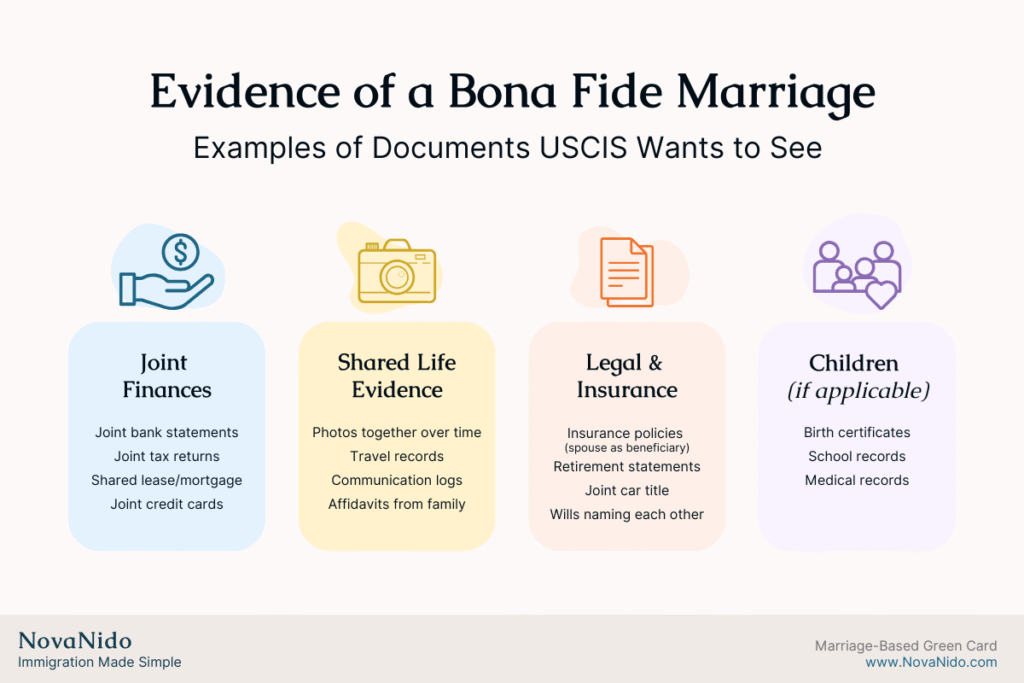
This is the part that makes most couples nervous, including us when we applied. USCIS and consular officers review evidence of a bona fide marriage to confirm your relationship is genuine—that you’re actually building a life together. The more evidence you provide across different categories, the stronger your case.
You don’t need to have everything on this list. The goal is to show a pattern of shared life across multiple types of evidence.
- Joint Finances:Evidence that you share financial responsibilities carries significant weight
- Joint bank account statements (showing regular activity)
- Joint credit card accounts
- Joint tax returns (filed as “married filing jointly”)
- Shared lease or mortgage documents with both names
- Utility bills showing both names at the same address
- Shared Life Evidence: Documents and materials that show you’re building a life together
- Photos together from different occasions, time periods and with family (dating, wedding, holidays, vacations, everyday life)
- Travel records showing trips taken together (boarding passes, hotel receipts, itineraries)
- Cards, letters, emails, or chat logs showing ongoing communication and relationship
- Affidavits from friends and family who know you as a couple (sworn statements describing your relationship)
- Legal and Insurance Documents: Official documents that name each other
- Health, auto, or life insurance policies listing spouse as beneficiary
- Retirement account or investment beneficiary designations
- Joint car registration or title
- Wills, trusts, or estate documents naming each other
- Emergency contact forms (employer, medical)
- Children (if Applicable):
- Birth certificates of children born to the marriage
- School records listing both parents
- Medical records showing both parents
Quick Tip: Quality matters more than quantity when it comes to bona fide marriage evidence. A few strong pieces of evidence from different categories—say, a joint lease, six months of joint bank statements, photos spanning your relationship, and two affidavits—is usually more persuasive than a massive stack of weak evidence. Focus on documents that clearly show both names and demonstrate your life together over time.
Financial Sponsorship Documents (Form I-864)
The U.S. citizen or permanent resident spouse must prove they can financially support the immigrant spouse. This is done through Form I-864, the Affidavit of Support, which requires meeting 125% of the federal poverty guidelines for your household size. IRS tax transcripts are the primary evidence — other documents below can further support your case.
- Tax Records:
- IRS tax transcripts for the most recent tax year (you can request these at IRS.gov)
- Three years of transcripts is better if available
- W-2s or 1099s for the most recent year
- Proof of Employment Income:
- Six months of recent pay stubs
- Employment verification letter stating job title, salary, and start date
- Proof of Self-Employed Income:
- Form 1040 schedules filed with your federal tax return
- Business tax returns
- Profit/loss statements
- 1099 forms received
Quick Tip: IRS tax records are the preferred form of evidence. If your income falls below the threshold, you can apply using a joint-sponsor, or with assets to meet the financial requirements.
For current poverty guidelines, check USCIS Form I-864P (updated annually).
Documents Specific to Adjustment of Status (AOS)
If you’re filing from inside the United States, you’ll need these additional documents for adjustment of status specific to the I-485 application.
Proof of Lawful U.S. Entry
This is critical—as the foreign spouse, you must show you entered the country lawfully.
- Form I-94 arrival/departure record — Print yours from the CBP website
- Passport page showing U.S. entry stamp
- Passport page showing U.S. visa (if you entered on a visa)
Medical Examination (Form I-693)
You, the foreign spouse, must complete a medical exam from a USCIS-authorized Civil Surgeon. The doctor completes Form I-693 and seals it in an envelope. This envelope is submitted with your application.
For detailed guidance on all AOS forms, see our Adjustment of Status Forms Checklist. To see a single complete Adjustment of Status checklist for documents, see our I-485 supporting documents checklist.
Documents Specific to Consular Processing
If you’re filing from outside the United States, you’ll complete Form DS-260 online through the Consular Electronic Application Center (CEAC) portal. Certain documents are specific to this consular processing pathway:
- Marriage certificates from any prior marriages
- Military service records if you’ve served in the military of any country
- Police certificates
Police Certificates
This is the requirement most consular processing applicants underestimate. Police certificates can take weeks or even months to obtain from some countries. Start this process immediately. You must submit police certificates from:
- Your current country of residence (if lived in for 6 or more months)
- Your country of nationality (if lived for 6 or more months in lifetime)
- Every country where you lived for 12 or more months after age 16
- Any country where you were arrested (regardless of how long you lived there)
Important: Police certificates typically expire after two years. Check the State Department’s Reciprocity and Civil Documents page for country-specific requirements—some countries have different procedures or may not issue police certificates at all.
Medical Examination (Panel Physician)
The medical exam for consular processing is different from AOS. It’s completed by an embassy-approved panel physician and is typically valid for 6 months for entry to the U.S..
Embassy-Specific Requirements
Requirements can vary by embassy. Ciudad Juárez, Manila, and other high-volume posts may have specific instructions. Always check the specific embassy’s website for your interview location.
Common Document Mistakes to Avoid
These mistakes cause delays, RFEs, and rejected applications. Avoid them:
Mistake #1: Missing Certified Translations
Every document not in English must include a certified English translation. The translator must include a signed statement certifying that the translation is complete and accurate and that they are competent to translate. Missing translations are one of the most common reasons for RFEs.
Mistake #2: Incomplete Divorce Records
You must prove that all prior marriages for both spouses have been legally terminated. This means divorce decrees, death certificates, or annulment papers for every previous marriage—not just the most recent one. A single missing document can stall your entire application.
Mistake #3: Weak Evidence of a Bona Fide Marriage
Wedding photos alone aren’t normally enough. USCIS wants to see evidence of your ongoing life together: shared finances, shared residence, communication over time, and third-party attestations. Aim for variety across categories.
Mistake #4: Forgetting Countries (Consular Processing)
For police certificates, you need documentation from every country where you lived for 12+ months after turning 16, in addition to your current country of residence and country of nationality if you’ve lived there for 6 months or more. Don’t forget countries where you studied abroad, worked temporarily, or lived briefly. Missing even one can delay your interview.
Mistake #5: Wrong Photo Specifications
USCIS and embassy photo requirements are strict.
- 2″ x 2″ (51mm x 51mm)
- White or off-white background
- Taken within the last 6 months
- Full face, front view, eyes open
- Name and A-number (if any) written on back of photographs with pencil or felt pen
Putting It All Together
The documents needed to apply for a green card through marriage vary by pathway, but the core requirements overlap significantly. Start gathering early, especially police certificates, foreign birth certificates, and certified translations. These can take weeks or months to get.
This list might feel overwhelming right now, but thousands of couples navigate this process every year – and you can too. Take it one category at a time, and you’ll be ready.
Get Your Free Marriage Green Card Document Checklist
Download our printable checklist. Every required document for both AOS and consular processing, bona fide evidence examples, and financial sponsorship requirements in an easy-to-follow, printable PDF format.
Takes 2 minutes to download—stay organized while gathering your marriage green card documents.
Following the AOS process?See our complete adjustment of status checklist for AOS Forms for form-by-form guidance, or documents for adjustment of status.
Disclaimer
This article provides general information about documents required for marriage-based green cards. It is not legal advice. Immigration laws and procedures change frequently. For advice about your specific situation, consult with a qualified immigration attorney. NovaNido is a document preparation service, not a law firm.