
You know you need to file for adjustment of status (AOS). You’ve been on the USCIS website. You’ve read the instructions. And now you’re staring at a confusing list of forms with numbers and letters, wondering: which ones do I actually need; did I miss any?
You’re not alone. The USCIS website lists dozens of different forms for adjustment of status, and it’s genuinely confusing which ones apply to marriage-based cases. Some forms are required for everyone. Others are optional but highly recommended. And a few depend on your specific situation.
Here’s what makes this so stressful: submitting an incomplete application doesn’t just slow things down. It can trigger a Request for Evidence (RFE) that adds 3-6 months to your timeline. Or worse, your entire package gets rejected and sent back
This guide breaks down all the usual forms for adjustment of status that you might need for your marriage-based green card. You’ll know which forms you need, who fills out each one, and how to organize everything into a complete package. By the end, you’ll have confidence you’re submitting the forms USCIS requires—nothing more, nothing less.
Let’s clear up the confusion once and for all.
Want a printable checklist? Download our complete adjustment of status forms checklist and keep track of every form you need.
Table of Contents
Forms for Adjustment of Status After Marriage: Required & Optional
Here’s the complete breakdown of all forms you need for adjustment of status after marriage to a U.S. citizen or green card holder. We’ll start with a quick reference table, then explain what each form actually does.
Quick Reference Table
| Form Number | Form Name | Who Files | Required/ Optional | Fee (as at Nov 2025) |
|---|---|---|---|---|
| I-485 | Register Permanent Residence or Adjust Status | Foreign spouse | Required | $1,440 |
| I-130 | Petition for Alien Relative | U.S. spouse | Required | $675 (filed by mail); $625 (filed online) |
| I-130A | Supplemental Information | Foreign spouse | Required | No fee (included with I-130) |
| I-864 | Affidavit of Support | U.S. spouse | Required | No fee |
| I-693 | Medical Examination | Foreign spouse | Required | No fee (doctor charges separately) |
| G-1450 or G-1650 | Payment Authorization | U.S. spouse | Required(choose one) | No fee |
| G-1145 | Electronic Notification | Either spouse | Highly Recommended | No fee |
| I-765 | Employment Authorization | Foreign spouse | Optional | $260 |
| I-131 | Travel Documents/ Reentry Permit | Foreign spouse | Optional | $630 |
Total filing fees for marriage-based adjustment of status (required forms only): $2,115 (if filed by mail), as of November 2025. This table captures general filing fees. Confirm each fee at time of filing using the USCIS Fee Schedule.
Core Required Forms
These are the essential forms for adjustment of status that every couple must submit. They’re mandatory for every marriage-based adjustment of status application. You cannot file without them.
Form I-485: Application to Register Permanent Residence or Adjust Status
This is your main application—the primary adjustment of status form that actually requests the green card. Your foreign spouse fills this out. Your foreign spouse fills this out. It’s long (over 20 pages), asks for biographical information, immigration history, and background questions. The I-485 is the centerpiece of your entire package.
Form I-130: Petition for Alien Relative
The U.S. citizen or green card holder spouse files this form to establish the family relationship. This petition proves you’re married and that the marriage qualifies your spouse for a green card. Without an approved I-130, there’s no basis for adjustment of status.
Need help completing Form I-130? Check our step-by-step guide to filing out Form I-130.
Form I-130A: Supplemental Information for Spouse Beneficiary
This is where couples often mess up. The I-130A is a supplement to Form I-130, specifically for the foreign spouse’s biographical information. It’s easy to overlook because it’s not mentioned everywhere the I-130 is. But USCIS requires it. Always submit I-130 and I-130A together for a marriage-based adjustment of status.
Form I-864: Affidavit of Support
The U.S. spouse fills out this form to prove they can financially support their spouse during adjustment of status after marriage. You’ll need to show income at 125% of the federal poverty guidelines for your household size. You’ll attach tax returns, W-2s, alongside other supporting documents. If you don’t meet the income requirement, you’ll need a joint sponsor to file their own I-864.
Form I-693: Report of Immigration Medical Examination and Vaccination Record
Your foreign spouse must complete a medical exam with a USCIS-authorized civil surgeon. The doctor fills out Form I-693, seals it in an envelope, and gives it to you sealed. Do not open it. Submit the sealed envelope with your application. You can find approved civil surgeons on the USCIS website.
Payment Authorization Forms: G-1450 or G-1650
You must include one payment form with your application:
- Form G-1450 if you’re paying by credit card or debit card
- Form G-1650 if you’re paying by bank account (ACH debit)
Choose one based on your preferred payment method. These forms authorize USCIS to charge the filing fees to your account.
Form G-1145: E-Notification of Application/Petition Acceptance
Technically optional, but you really should file this. Form G-1145 allows USCIS to send you text and email notifications when they receive and process your application. You’ll get your receipt numbers faster, and you can track your case online immediately. It’s free and takes two minutes to fill out. Place it on top of your entire package so USCIS scans it first.
Optional Forms You Might Need
These forms aren’t required for adjustment of status after marriage. However, many couples file them because they may provide useful benefits while your green card application is pending.
Form I-765: Application for Employment Authorization
If your foreign spouse wants to work in the United States while waiting for the green card, file Form I-765. This requests a work permit (Employment Authorization Document or EAD). Processing takes 4-6 months on average as of November 2025.
Form I-131: Application for Travel Documents, Parole Documents, and Arrival/Departure Records – Reentry Permit
If your foreign spouse needs to travel internationally while their green card application is pending, file Form I-131 for advance parole. Without this document, leaving the United States could abandon your adjustment of status application. In other words, they’d have to reapply for a green card from the beginning.
Should you File I-765 and I-131 with Your I-485?
Couples often wonder whether to file for work authorization (I-765) and travel permission (I-131) at the same time as their adjustment of status application.
Reasons to file together:
- Less paperwork—one submission instead of several
- Starts the clock on processing sooner
Reasons to skip:
- Your spouse won’t work or travel during the 8-20 month wait
- You want to save $890 in fees (I-765: $260, I-131: $630)
There’s no one-size-fits-all answer. It depends on your situation and priorities.
How to Organize Your Forms Package
Organization matters. A well-organized package is easier for USCIS to process, which can mean faster approval. Each adjustment of status form should be clearly organized with its supporting documents.
Suggested Submission Order
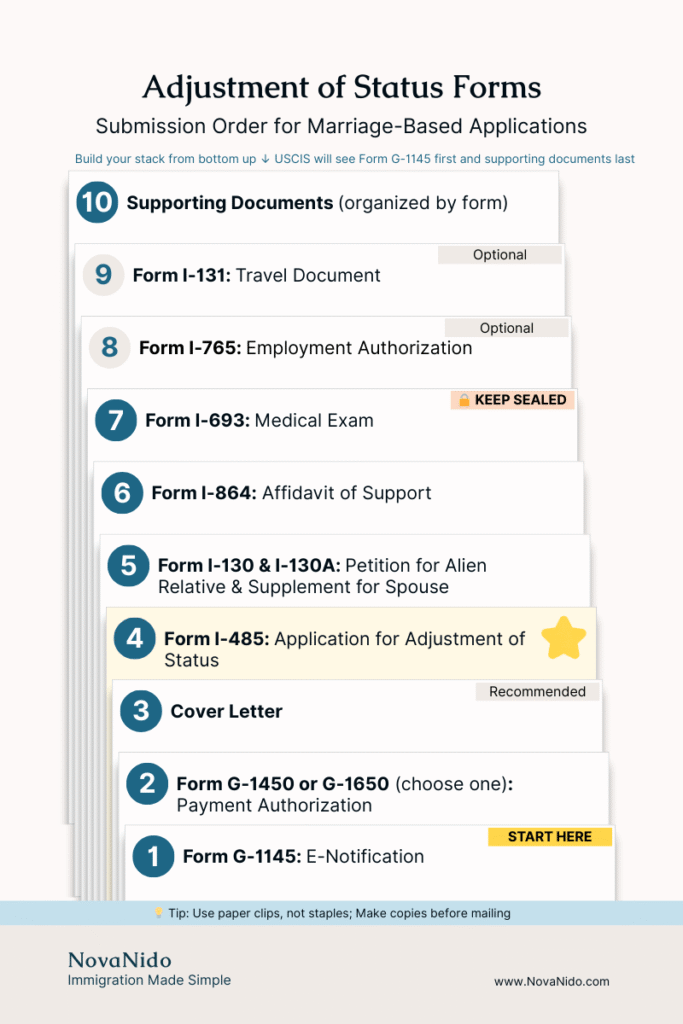
Organization Tips
- Use paper clips, not staples. USCIS will need to scan your documents. Paper clips make their job easier.
- Make complete copies before mailing. Copy every form, every document, every page. If USCIS requests additional information, you’ll have exact records of what you submitted.
- Check form edition dates. Before you seal the envelope, make sure each adjustment of status form is the current edition by checking the bottom left corner.
- Create a cover letter. A simple one-to-two-page letter listing all included forms and supporting documents included. This helps USCIS process your package. Not required, but professional and helpful.
- Use certified mail with tracking. Send via USPS certified mail or a courier with tracking. Keep your tracking number and delivery confirmation.
Get Organized: Download our Complete AOS Forms Checklist to print and use while assembling your package. Includes all form numbers, current fees, and submission order.
Where and How to Submit
You have two options for filing: online or by mail. As of November 2025, some forms can be filed online through your USCIS online account, but not all. Check the current online filing availability on USCIS.gov, as this changes frequently.
Mailing Your Application
If filing by mail, the address depends on your location. Always verify the current mailing address on the USCIS filing locations page before sending your package. USCIS occasionally changes lockbox addresses.
Common Mistakes: Using an old address from a blog post, or assuming the address is the same for everyone. Always double-check the official USCIS website right before you mail.
Tracking Your Package
Use USPS certified mail or a courier service with tracking (like FedEx or UPS). You’ll want proof USCIS received your application. Save your tracking number and delivery confirmation just in case.
What Happens Next?
Within 30 days of receiving your package, USCIS will send receipt notices (Form I-797C, Notice of Action). You’ll get a separate receipt notice for each form that needs approval. This is usually one for I-485, one for I-130, one for I-765 (if filed), one for I-131 (if filed). These notices confirm USCIS received your complete forms for adjustment of status package and has begun processing.
Each notice includes your receipt number. The receipt number starts with three letters and is followed by ten numbers (for example: IOE2190123456). You’ll use these receipt numbers to track your case online.
If you filed Form G-1145, you’ll also receive text and email notifications that include your receipt numbers. These are usually sent within a few days of USCIS receiving your package. It is much faster than waiting for the paper notices in the mail.
Next, you’ll receive a biometrics appointment notice, usually 5-8 weeks after filing. You’ll go to a local USCIS office for fingerprints, photos and signature.
Ready to Submit Your Adjustment of Status Forms?
You now know exactly which forms you need, how to organize them, and where to send them. Getting the forms right is the foundation of a successful adjustment of status application.
Your Next Steps
- Download the forms: Get current editions of all required forms from USCIS.gov
- Check your eligibility: Make sure you meet all requirements for adjustment of status after marriage
- Gather your documents: Beyond forms, you’ll need supporting documents—see our complete AOS documents checklist
- Organize and mail: Use the checklist and submission order from this guide
Thousands of couples successfully file their adjustment of status applications every year. The key is being thorough, organized, and following USCIS instructions exactly. You’ve got this.
Get Your Complete Adjustment of Status Checklist
Download our printable AOS checklist. Every required form, current fees, and submission order in an easy-to-follow, printable PDF format.
Takes 2 minutes to download—ensure you have all the forms you need before you mail your package.
Disclaimer
This article provides general information about adjustment of status forms for marriage-based green cards. It is not legal advice. Immigration laws and procedures change often. For official up-to-date information, check USCIS guidelines. For advice about your specific situation, consult with a qualified immigration attorney. NovaNido is a document preparation service, not a law firm.